Here’s the second part of my PAX account. By the way, I’ve started that photo gallery on deviantART, but I’m still looking for pics. Thanks again!
Category: Archive
One quick note before I begin: I’m looking for PAX East cosplay pics on deviantART. If you see (or have added) any over there, please post a reply with a link or links; thanks.
Now, on with the post, which is rather long, even though it’s just the first part. Co-starring my partner in crime; some of you may know him by his old FFVII Citadel handle, Cyrus Dogstar.
Beat Devil May Cry 4 last week. Not the best game in the series, but certainly had its high points. All the hallmarks were there: bishies, hot chicks, gothic interiors, death metal songs that play during battles, and occasional violations of the 180° rule when moving from place to place. Unlike the others, Dante is not playable for much of the game. Instead, the player takes the role of Nero, a young man with similar fashion sense and slightly less campiness than Mr. Sparda. He also has a glowing arm, which can be used to grab far-off enemies and unleash brutal attacks on them. These attacks vary depending on the enemy, reminding me of Quick Time Events, though not in the traditional sense. As such, Nero is a fun character to play. Dante controls much the same as always, and is also tougher to control compared to Nero, due to the lack of Glowing Hand.

As for Rune Factory Frontier, I’m still plugging away at it, and passed the 100-hour mark this weekend. All that has been ever said about JRPGs and linearity doesn’t quite apply to the Rune Factory series. Yes, there is a single storyline and a set progression in terms of unlockable areas, and no, you can’t fully customize your hero character, but everything else is wide open. There’s tons of things to do—farming, fishing, crafting, cooking, and much more—and like any good Harvest Moon, there’s also a wide range of girls to hit on, and eventually, marry. It’s rich and immersive in a way that JRPGs traditionally aren’t, and despite the glaring flaws, I’m as hooked on Frontier as I was with its DS brethren. Can’t wait for Rune Factory 3‘s localization (please let this happen!).
Apart from games themselves, I’m getting a little weary of CAG’s forums again and am ready to take another hiatus from them, largely due to the fact that there’s hardly any humor in them. This seems to be a problem with many gaming forums, where games are Serious Business and there’s little to no room for levity. Perhaps this also explains why Shimrra won Best CAG Blog in this year’s Cheapy Awards, even though his regular Daily HaHa posts are mainly just images ganked from the likes of 4chan. Humor is in very short supply amongst gamers, it seems.
Anyway, looking forward to PAX East at the end of this week, and have been going over my options for what to see and do. Meanwhile, I will be playing Cave Story. On my Wii.
Best gaming week ever? It’s looking that way.
Special Stage: Cracked‘s gaming articles are funny, but also tend to contain nuggets of truth. Thanks to my husband for linking me to “5 Creepy Ways Video Games Are Trying to Get You Addicted”, which is one of the latest, and chock-full of said nuggets.
Though it may seem otherwise, Ace Attorney Investigations: Miles Edgeworth (referred to as AAI from here on in) is not an easy game to pigeonhole. It could be considered as either a spinoff of the main Ace Attorney series or a full entry in its own right. It is the first and only Ace Attorney to feature both a prosecutor as the main character and a heavy emphasis on crime scene investigation. However, it’s as lengthy and as well written as many of its predecessors, and represents an evolution of, rather than a complete break from, the core Ace Attorney formula.
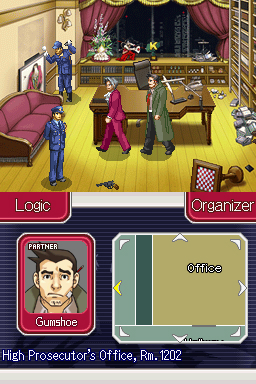 Spinoff or not, there’s no denying that this is a different sort of Ace Attorney. Set sometime after the events of the third game (Phoenix Wright Ace Attorney: Trials and Tribulations), it stars Miles Edgeworth, a savvy public prosecutor who’s both friend and foil to defense attorney Wright. It opens in Edgeworth’s office, where there’s been a murder, and the cases that follow only get bigger and messier from there. The goal of the game is to find the culprits for these cases by analyzing evidence and other information gathered throughout the course of the investigation. Typical for the series, AAI is funny and well-told, and while the plot can be predictable at times, in general, it is solid, anime-flavored drama. However, the localization suffers in spots from awkward grammar and typographical errors. It is far from the worst game localization I’ve ever seen, but it could’ve greatly benefited from an extra round of editing and polish.
While convoluted murder cases are a hallmark of Ace Attorney, how they are handled is what truly sets AAI apart. Previous games took place entirely from a first-person point of view for the investigation phases, and only showed the main character during trials. In AAI, Edgeworth is represented onscreen nearly all the time. When he’s not in his typical 1/4 front portrait view, he’s a sprite on the top screen of the DS, and can be made to walk or run around his environment. This comes at the expense of the freedom to move between several different locations, as Ace Attorney‘s defense lawyers did, but is realistic within the context of the story, particularly when dealing with partner characters—no more running back to the office just to speak with your assistant! Other new features include the “Logic” command, where Edgeworth pieces together things he has noticed in order to explain something within the scene, and a device that recreates crime scenes, AAI‘s subtle, and suitable, upgrade from the previous games’ magical MacGuffins.
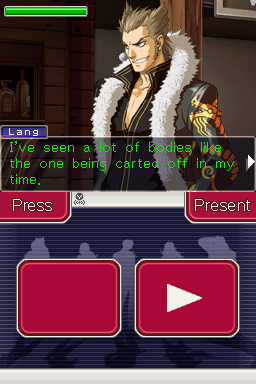 What else is different? The post-investigation phase in an Ace Attorney game typically involves a courtroom showdown, but not in AAI. Edgeworth still takes testimony and presses both witnesses and suspects, sure, but all of this action takes place right on the scene, and as such, is very tightly integrated with the investigation phases.
If all this sounds like a radical departure from the old formula, it’s one that fans need not worry about, as there’s much that hasn’t changed. The basic interface, for one, as well as the fact that the entire game (except for saving functions) can be played with just the touchscreen if one prefers. Speaking of controls, the ability to shout “Objection!” using the microphone has returned. Also handled in a familiar way are the first-person crime scene examinations, where a specific area can be searched for evidence; likewise, the basic process of interviewing witnesses and presenting evidence to them is the same as it’s always been. The visuals and music are stylistically consistent with the rest of the series, though the majority of the reused art assets—such as the portrait views for Edgeworth—have been given a much-needed facelift.
One “feature” that has been in the series all along—and is also present in AAI—is the methodical process that pervades throughout the cases, and the testimonies in particular. Often, it’s not all that difficult to figure out just what is going on at certain points in the story, but jumping too far ahead in one’s conclusions can have dire consequences, and the correct answers can be rather obtuse. Perhaps it is because I’ve played the previous games and am used to the Ace Attorney thinking process, but I encountered such stumbling blocks far less in AAI. That, along with the lack of real make-or-break, nail-biting moments, has made for what’s possibly the easiest Ace Attorney yet.
While we’re on the subject of familiarity: as mentioned before, there are many throwbacks to earlier titles in the series. From the appearance of beloved characters like police detective Dick Gumshoe, to tiny, Easter egg-like details, there’s much here that will put a smile on any Ace Attorney fan’s face. However, this has come at the expense of introducing more new characters to the canon; while there are some, the amount of them feels insufficient when compared to the earlier games. This heavy reliance on familiar elements, while not bad in and of itself, is the most spinoff-like aspect of AAI, and weakens its case for being a good starting point for newcomers.
So, is AAI just a spinoff, or a true Ace Attorney game? The verdict points to somewhere squarely in between. It’s a great adventure game, with a lot of excellent ideas that I’d like to see put to use in future Ace Attorneys, but it also relies heavily on the past, and has a localization that isn’t quite up to par with those of its predecessors. If you’re a fan, especially an Edgeworth fan, you’ll probably love it. AAI is a fan’s game, and while I don’t doubt that newcomers to Ace Attorney can and will enjoy it, one gets the sense that they’re not really who it was made for.
I started Devil May Cry 4 last night. One of the main things that stuck out at me during the opening cutscenes was not the camera work, nor the music, though those were nice. Rather, it was the fact that here we were, in a vaguely Old World European setting—set in the current day, sure, but there were monks and such everywhere, and not a single bit of modern architecture in sight—and one of the main characters, Nero, walks in, wearing not just the requisite long coat with zippers and red and black trimmings, but headphones.
Headphones. Big stereo headphones, too.
They just seemed out of place to me, though pretty run of the mill for the DMC universe.

They also reminded me of this illustration book, which I saw late last year in NYC’s Kinokuniya. It’s sort of a collection of headphones moe, if you define moe as having to do with idealization, or a particular fetish. The other major definition of moe is more specific, and refers to a certain type of feminine innocence.
As such, there isn’t much discussion of “male moe”, though it exists. Certainly, there are characteristics among bishonen that pop up again and again in Japanese comics, animation, and video games. Nero and his DMC4 co-star (oh, that’s gotta hurt) Dante have such “moe points” in spades, from the aforementioned coats, to their huge (*cough*) swords, to the stylings and very color of their hair.
White and grey-haired males have long been popular among gamer girls, especially villains. Yet another Devil May Cry character, Dante’s twin brother Vergil, is a fine example, as is FFVII’s Sephiroth, not to mention the star of the other Capcom game I started yesterday, Ace Attorney Investigations: Miles Edgeworth. Though not the only pale-haired prosecutor in the series, Edgeworth—defense lawyer Phoenix Wright’s friend and rival—has been a particular favorite amongst Ace Attorney fans since the first installment. This new game, in which he is the main character, has been long awaited by many of us. Given Edgeworth’s role in the series, it is also different from the other games in that it focuses on the investigations and avoids court scenes altogether. I’m currently in the midst of the game’s second episode; although the writing isn’t as good as it could be at times, I’m enjoying my time with Edgey. The Ace Attorney flavor is there, and that’s what’s important.
As for Devil May Cry 4, I haven’t gotten far enough into it to form a strong opinion yet, but I will say that it seems a little clunky and old-fashioned in the way that it does things, albeit with shiny graphics. We’ll see how the game shapes up once things really get rolling.
For the past few years, I’ve been tying up some final loose ends in the old school JRPG space. I never set out to play everything—for instance, I’ve no plans on touching Xenogears, for an assortment of reasons—but there have been a handful of titles that I’ve slowly been getting around to. Last year’s non-port, non-remake relics were Earthbound and Secret of Mana; I didn’t like them, but couldn’t hate them, either. The former was archaic (even for the time) and sported certain horrible and frustrating bits of game design, but its charming atmosphere made it easy to see why it has garnered a fervent fanbase to this day. The latter has a clunky interface and AI, overenthusiastic animation, and a rushed translation, yet the rest holds up fairly well, and in general, the game wears its ambition proudly.
This year’s major relic is Chrono Cross, the PS1 sequel to a Super Nintendo game made by a once-in-a-lifetime “Dream Team”; a console RPG which has since become one of the most beloved of all time. With such a pedigree, Chrono Cross has a lot riding on it. On top of that, aside from executive producer Hironobu Sakaguchi and composer Yasunori Mitsuda, none of the most recognizable names from the aforementioned original game’s “Dream Team” show up here. This doesn’t bode well, but it’s unrealistic to believe that Chrono Cross would equal or even surpass its legendary predecessor, right? As long as it works, there shouldn’t be much to worry about, right?
Well, therein lies the rub. Chrono Cross doesn’t work, not as a whole. Rather, it should, it ought to, parts of it do sometimes, and it contains so many things that could make everything work, but they all fit together in the wrong way, or too much glue is used in one place, and not in another. The result is a goopy mess of wasted potential, a skunk works project that looks good on the surface, but creaks at the seams.

This is a JRPG where the protagonist adventures with only the barest of motivations even after a few hours in, and with little to no pressure from outside forces pushing him forward; sometimes, when said pressure does come to bear on him, events then progress in a such a way that make absolutely no sense in the context of what happened even just a scene or two before. This is a tale where, whenever the central plot rears its ugly head, it starts out presenting itself in a natural and fluid way, then bombards you, via whatever deux ex machina device happens to be available, with tons of information that confuses things once again before, during, and/or after a major boss fight. This is a plot in which, toward the end, when things do kind-of sort-of make sense now, the last little bits thrown at you are absolutely ludicrous and makes you wonder what kind of crack the writers were smoking.
This is a game that commits one of the gravest crimes of game design: instead of guiding the player whenever necessary, it makes assumptions of them. It assumes that the player will go in a certain direction once heading to a new town with an open main square that happens to have several branching paths, so that the entire place can be explored before triggering the very cutscene that hints as to you why the townsfolk were talking about the things they were. That’s not a problem, but what is is that it also assumes that the player will remember every single snippet of conversation, amongst many dozens of characters and across several locations, that takes place throughout the course of the game. As such, this is a game in which a strategy guide or online walkthrough won’t be wanted merely for the optional stuff (and there’s a ton), but just for figuring out how to progress through the damned story. I don’t know how much is the fault of the localization—the PlayStation era was hardly a golden age for English translations of Squaresoft games—or the writing itself, but either way, a game like this should not have a narrative structure this sloppy.
Then there’s the battle system, which confuses simplicity with elegance, and complexity with depth. This may sound strange considering the genre, but in the Chrono Cross system, there are just too many numbers. Don’t get me wrong; it’s not the numbers themselves, but the types of numbers. There are percentages and decimals all over your average battle screen, along with blinking graphs for your Elements (Chrono Cross‘ version of spells and healing items) and your usual HP indicators. It’s a system that closely integrates turns with three different grades of physical attack, the aforementioned Elements, field effects, and summons that are both rare and borderline useless. Leveling has been completely done away with, but party members can still earn stat upgrades at the end of each battle, which kind of makes one wonder what the point of having no levels is. It’s a highly unusual and experimental battle system—par for the course for a ’90s Square JRPG, when you think about it—but suffers from the same syndrome that Kingdom Hearts II did in that the regular enemies tend to be too easy, while certain boss fights ramp up the difficulty a noticeable amount. Even with the latter taken into account, it’s possible to run away from several boss battles, including the very last one, so perhaps I’m overstating the difficulty there.

And speaking of the final boss, there are two options to dealing with it, and one of them requires an item that is talked about many times, but can only be obtained by going someplace that isn’t labeled on the map and is referred to but once or twice (without any clear indicators that You Should Go There) during the regular course of the game. Using this item, well, that’s another matter entirely. Let me save you the trouble: unless you really, really like exploring, don’t bother searching for hints in the game—if you want the “good” ending, skim through an FAQ to get the details.
However, before you think that this review is all negative, rest assured that there were some things I liked about Chrono Cross. While I found main character Serge to be bland—even for a cipher—and heroine Kid a bit annoying, there were some cast members I genuinely liked, such as Norris. Certain references to the game’s predecessor that popped up early on were kind of cute. For the most part, and despite the ugliness of PlayStation graphics in general, the visual aesthetic was nice. One of the main subplots was largely enjoyable and quite touching, although a certain track associated with it wore out its welcome really fast. And speaking of music, Yasunori Mitsuda’s score was great; I went in thinking that I wouldn’t like it, as I’d been overexposed to a handful of pieces over the years, but the soundtrack as a whole grew on me.
So, in summation, don’t play Chrono Cross, especially if you’re, like me, someone who loved its predecessor to bits and would be put off by an inferior battle system and convoluted, inelegant lump of a story. Just go straight to your favorite Japanese import game music retailer and plunk down ¥3,204 or thereabouts for the soundtrack instead. That way, you’ll get one of the very best parts of the game without actually having to play it!