Press "Enter" to skip to content

Category: Archive

Shiren’s Quest, Serge’s Floundering

Mystery Dungeon: Shiren the Wanderer was my first “real” roguelike, and it was fantastic, but also nerve-wracking. I almost didn’t want to beat the game. It wasn’t because I was enjoying it too much, though there was some of that, too. Rather, I was afraid of the consequences I would face should I fail. Already I had died numerous times, and after every instance, I was whisked back to the starting town of Canyon Hamlet with all experience and stat boosts vanished into the aether, and all of the items and money on my person gone as well. To have this happen to me once I passed the point of no return, and with some excellent customized equipment to boot, would’ve been devastating. Such are the risks in Shiren, but it made the joy and sense of accomplishment that much sweeter once I reached my final destination.

Shiren is a DS port of a 1995 Super Famicom game, and a spinoff of a Dragon Quest spinoff. This latter bit is important, since the music in a certain dungeon struck me as very Koichi Sugiyama, and lo and behold, it turned out that the DQ series composer was responsible for Shiren‘s excellent soundtrack. While I was playing, it was pointed out to me that the lack of absolute permanence in death separates it from the oldest adherents to the roguelike genre, including Rogue itself. In fact, not only is death impermanent though inconvenient (for the reasons I stated in the first paragraph), but starting over again and again is encouraged. There’s not much to the main story, but to take full advantage of the game’s features and build Shiren up into a warrior worthy of taking on Table Mountain’s heights means completing various sidequests, most all of which require several cycles of restarts from Canyon Hamlet for maximum effect. These sidequests typically involve helping other people in the area, and the results can be anything from a new party member to a free stat boost.
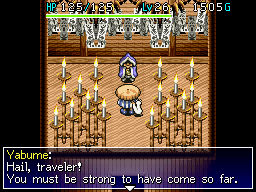
Mystery Dungeon: Shiren the WandererThis is a game that, much like life itself, rewards perseverance, patience, and effort. Though it’s not for everyone, for fans of tough-as-nails dungeon crawlers, I can’t recommend it enough. A Wii sequel, simply released in the US as Shiren the Wanderer and said to be more forgiving than the Shiren of old (a la Final Fantasy Fables: Chocobo’s Dungeon), came out earlier this week and has been getting good reviews so far. I definitely plan to pick it up sometime, but not right away, because, you know, RPG-heavy backlog and all.

Since wrapping up Shiren, I’ve moved on to another of my Must Plays for 2010, namely, Chrono Cross. Even before starting this game, my feelings on it were mixed. This was due to a blend of my strong affection toward its immediate predecessor, Chrono Trigger; the varied opinions on the game floating about on the internet; and the overexposure I had to Yasunori Mitsuda’s soundtrack, thanks to places like the now-defunct Gaming FM. Still, I wanted to keep an open mind, and went into the game knowing as little about it as possible.

I’m currently about twelve hours in, and am finding it to be… interesting. It has appropriated some of Chrono Trigger‘s better ideas, the most noticeable one being the lack of enemies on the overworld, and has thrown in a few cute tiny references to said previous game, from familiar lines and names to certain musical themes. There’s other throwbacks as well, but what’s most striking about Chrono Cross is what is different. Instead of time travel, the theme this time around is parallel dimensions and alternate histories, which is intriguing on its own, but I can’t help feeling that more could’ve been done with it. Maybe more will be, but something tells me that the Cross world won’t approach the depth and variety of Trigger‘s.

Another thing that’s substantially different is the battle system. A great amount of emphasis is placed on physical attacks, which are separated into three tiers, based on accuracy and power, and each one costing a certain number of turn points. The successful execution of these attacks tie into the use of Elements, which serve as both magic and healing items in this game. On top of that, Elements come in six colors, and their usage affects the overall field of battle, as well as the effectiveness of summoning, which I haven’t had a chance to mess around with yet. It’s a complex-looking system, but easy to grasp the basics of after a few hours. Unfortunately, it’s also rather dull, due largely to the physical attack emphasis I mentioned at the beginning. The generally low difficulty curve doesn’t help either.

The writing in Cross leaves much to be desired. Main character Serge is a silent hero, like Crono was before him, and I don’t have much of a problem with that. Other characters, however, are too vague about their motivations, fickle in their treatment of me, and/or generally don’t provide enough of a reason for me to care about the fate of this alternate world that I’ve found myself in. Kid in particular seems to have been designed as Cross‘ answer to Trigger‘s Marle, but she’s neither as interesting nor as fun as her predecessor. There’s also the matter of pacing, and when and how certain scenes are triggered. For example, I could explore an entire town and listen to various people discuss how to get into a certain place for no apparent reason, then go into an area I bypassed early on, only to have a cutscene happens where Kid goes, “Hey, let’s try to get into (certain place)!” Now you wouldn’t think this would be a problem, but going by the dialogue and the town’s layout, I got the impression that I was supposed to go to this specific area first, and then find out the details on how to get into the place that Kid mentioned by exploring the town.

Anyway, I’m sticking with Chrono Cross, just to see where it all winds up, and also to see if my experience will improve any.

Special Stage: First up, some sad news: P.S. Triple’s run on 1UP officially ended last week. No new strip, just a goodbye message, and a reminder that the iPhone apps are there if anybody wants ’em. I’ll miss the adventures of Triple and the others, especially X-Locks and most especially Saygah, who I’ve since made my avatar on CAG. I’ve also been working on a piece of Triple fanart, but it’s not done yet; knowing me, it might be awhile. Anyway, thanks for the fifty strips you did bring us, Micro Magazine and Mission One!

Gus Mastrapa’s piece “21st-Century Shooters Are No Country for Old Men” is a lamentation of being a thirtysomething FPS gamer in a landscape dominated by youngsters. I haven’t touched an online multiplayer FPS in at least five years, but I can totally see where Gus came from in his article. The most remarkable part of this piece was the comments section. On GameLife, whenever there’s this many comments on a piece, it usually means there’s a good old fashioned flamewar going on. However, the comments here are from other adult gamers, like Gus, who have encountered teenagers and college students on virtual battlefields, and all the frustrations that can ensue. They shared their own stories and gave tips for how to enjoy oneself as an older FPS player. Great stuff all around. If you don’t want to wade through it all, there’s a follow-up piece here, highlighting some of the best comments and emails Gus got.
The Latest Hybrid Model

There’s been a lot in gaming press, blogs, and messageboards lately about how Japanese RPGs are stagnating. With the arrival, en masse of high-quality Western RPGs on consoles, history is repeating itself. Remember what happened when console gamers discovered what good first-person shooters and built-in modding/customizing tools were like? Halo was not a big deal to those of us who had previously played everything from Wolfenstein 3D onward, and Little Big Planet looked nice, but was it really going to revolutionize things when powerful—but not overly intimidating—modding tools like UnrealEd were old news?

Anyway, like I said, there’s a lot of whining about how JRPGs have gone downhill, and some people think that the best way to fix them is to, generally, make them more Western. Such homogenization isn’t the best approach (and wouldn’t make the core JRPG consumer base happy), but what is? While some JRPG series (most notably Dragon Quest, Tales, and Pokemon) soldier on with high-quality, well-received main entries, other games have been seeking different approaches. There’ve been some novel experiments (Valkyria Chronicles, The World Ends With You), but more commonly, we’ve seen a lot of hybrids.

Hybrid RPGs are not easy to pigeonhole, and they’ve always kinda-sorta been around in one form or another, but the past few years have really seen them come into their own. For evidence of this, RPGamer’s Best of 2009 Awards is worth a look. While more traditional RPG fare took the top prizes, many genre blends popped up in other categories: SRPG/shmup Knights in the Nightmare, RPG/microgame mashup Half-Minute Hero, dungeon crawler/farming sim Rune Factory Frontier, and so on. The phenomenon isn’t limited to Japan, either, one of the more recent examples being the Western-developed puzzle RPG Might & Magic: Clash of Heroes, likewise mentioned in the Best of 2009. Clearly, RPGs mixing with other genres is a growing trend, and going by the quality of the hybrids I’ve played so far, it’s one that I personally would like to see continue.

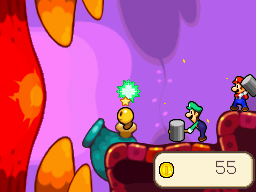
Mario & Luigi: Bowser's Inside Story - Lending Bowser a hand, through minigames!One of the original hybrid RPG stars has been, not unexpectedly, Mario. First in Super Mario RPG, then in the Paper Mario and Mario & Luigi games, the portly Italian plumber’s RPG adventures intermingle with the precise jumping and timing that define his platforming exploits. The Mario & Luigi series in particular adds an extra layer of challenge by having you control both Mario Bros. on the field at the same time, and eventually, special moves become available that can only be pulled off when the two are together. The second game, Partners in Time quadruples the party when Baby Mario and Baby Luigi join their older selves on the quest. This was also the first game in the series to appear on the Nintendo DS (the original was on the Game Boy Advance), occasionally reserving the top screen as the babies’ domain, with special areas only they can explore, for when they aren’t riding piggyback on the adults.

The latest Mario & Luigi game (and the last Mario RPG ever made that I had left to play), the Fall 2009 release Bowser’s Inside Story, is likewise on the DS, but this time, the party is reduced to three: Mario, Luigi, and perennial bad guy Bowser. The basic plot is that the Mushroom Kingdom has been hit hard by a disease called the Blorbs, which causes the local Toads to swell up into obese giants. Meanwhile, Bowser is, yet again, planning to kidnap Princess Peach when, along the way, he eats a strange mushroom which causes him to swallow up the Princess, Mario, Luigi, and half the Kingdom. Mixed in with all this is the delightfully mad Fawful, Cackletta’s henchman from the first game who comes back as a full-fledged villain here. While Mario and Luigi explore Bowser’s body to try and find a way out, Bowser commences on his own journey. What comes out of their adventures is one of the strangest symbiotic relationships the Mario canon has seen yet.

The hallmarks of the series are all present—the platforming, the special moves, the hidden items, the funny script, and so on—but a third major element has been added to the mix of RPG and Platformer: Minigames.

Special Stage Extra: Let’s Rock, Baby

Aside from being busy with other things, I’ve been playing a lot of Mario & Luigi: Bowser’s Inside Story, an intriguing game of mushrooms, chortles, and globin. However, today’s post isn’t about that, as I’ve not yet beaten it (actually, I’m very near to the end, so expect that entry soon); rather, today I have a roundup of links which have caught and/or been brought to my attention lately.

If this isn't girly, I don't know what is.

Bayonetta has been on my mind for a long time now, and even though it’s finally out, it’s not so much of a priority that I went out and got it right away. Still, I’ve been reading and hearing things about it here and there. The most interesting piece I’ve come across so far is Leigh Alexander’s Bayonetta: empowering or exploitative? She makes a great case for the title character being a truly feminine protagonist. I played the demo not long after reading this piece and through that small glimpse, I can completely see what Alexander is getting at. Bayonetta is sexy and appealing, sure, but she’s also not just a male character in a female skin—she really is feminine. I think a lot of it’s in the details, like the blown kisses, the butterfly wings that sometimes appear on her back, and the way she reacts, in a cutscene, when flowers sprout up from the ground beneath her feet. It’s all so stylish, but I expect no less from the designer who previously gave the world another sexy piece of eye candy in the form of Devil May Cry‘s Dante.

Speaking of which, a new printing of Dante Alighieri’s poem Inferno is now available in bookstores, with a cover that has to be seen to be believed. Both aghast and amused, I took the news to Fandom Lounge to share this horror with others; there are many gamers who frequent the group blog, but also many more avid readers, and their own reactions were not unexpected. The wallpaper-sized version of the obligatory Penny Arcade comic that followed has been trimmed down and is now on my desktop.

Cheers to StarKnightX over at the CAG Forums for posting the link to Bitmob’s article Dangerous Ideas to Improve the Video Game Industry. I don’t know if I agree with some of the points made, but in general, it’s a thought-provoking piece, and well worth a look.

Finally, something funny I ran into while lurking over at a certain forum, as I do every so often: a comprehensive BioWare RPG Cliché Chart. A great companion to the classic Grand List (see the Links page for that if you don’t know what I’m talking about), and, from what I can tell, about as spoilerific, so take care.

The Fun Driving Simulator

You wouldn’t know it by reading this blog, but one of the few video gaming genres I have loved unconditionally my entire life, ever since I was old enough and tall enough to reach the sticks on arcade cabinets, has been car driving and racing. I have fond memories of Pole Position; consider the OutRun soundtrack to be the greatest in the medium’s history; have smiled with Cruisin’ USA, gritted my teeth courtesy of Crazy Taxi, and laughed over manic multiplayer Mario Kart DS sessions. And even though I eventually gave up on Grand Theft Auto: Vice City, and open-world games in general, I took immense pleasure in simply cruising around a loving parody of the very real Miami Beach that I had spent much time in when I was younger, listening to the ’80s tunes and satirical talk shows on the radio. All of this is especially ironic since I have no interest in driving in real life and, in fact, only ever did so for a very short time.

Forza Motorsport 2 - screenshot 1But yes, I love driving games, even though I’m not very good at a lot of them. This last bit is why I don’t buy them all that often, and why, until recently, the first and last simulation racer I had ever bought was Gran Turismo 3 A-Spec, which came bundled with my first PlayStation 2. I had heard fantastic things about the Gran Turismo series, and this latest (at the time) entry in the series looked damned pretty, so for this casual driving game lover, I thought it was a no-brainer. However, my problem was just that: I was a casual driving game lover, and GT3 was very, very serious. In career mode, I got a starting car and some circuits to race on, but to save up enough money to upgrade from my lowly PT Cruiser was going to be a tedious task, and I never stuck with it. Of course, it didn’t help that the license tests, required to unlock the higher-level races, demand a certain sort of precision which my casual self couldn’t possibly hope (or want) to deliver.

I eventually set Gran Turismo 3 aside for other games, including the simpler but much more accessible go-kart racer Mario Kart DS, and ended up never touching it again. Another console generation rolled around. I picked up Mario Kart Wii and went through the entire Grand Prix in that, as I had with its predecessor, but it wasn’t enough. I wanted a more robust racing experience, something like Gran Turismo, but given my past experience, I had to do my research more carefully this time. We don’t have a PS3, but we do have an Xbox 360, and the Xbox brand’s equivalent of GT was Turn 10’s Forza Motorsport, so I began looking into that series. I already knew of its reputation for delivering as deep and realistic an experience as Polyphony Digital’s “Real Driving Simulator”, but could I play a Forza game and still have fun?

The answer? A resounding yes.

Everlasting Love

When I saw the “Game of the Decade?” thread on the Cheap Ass Gamer forums, I took the title more into consideration than the post itself. The “best” game of the ’00s? Even now, I’m still not sure about that. However, the game that best defines the past decade? When I posted my reply, it was based largely on a gut feeling, and one I still feel pretty good about. So anyway, here is the answer I gave, and now, I will also tell you why this game fits the bill.

Many splendid things can be picked up in We ♥ Katamari. Much love to llshibata on flickr for saving all the original official Katamari wallpapers.Game of the Decade:
We ♥ Katamari (PS2, 2006)

Thought I’d say something grander and/or more obvious, huh? Nope. My pick for GotD is the sequel to the idiosyncratic Katamari Damacy which, on the surface, merely looks like more of the same. However, not only is it a bigger and better game than its predecessor, but it also serves as a compact time capsule of much of the past decade in gaming. Here is why We ♥ Katamari is important in these terms:

It’s the quintessential auteur game in a decade full of them – …and few of the newer video game auteurs have been as genuinely creative as Keita Takahashi. The designer of the original Katamari, Takahashi wasn’t originally all that enthused about a sequel, but got on board for one all the same. What resulted wasn’t just a great game, but also one that was strikingly personal in a way that was and is rare for the medium: the plot this time around has to do with the King of All Cosmos (i.e., Takahashi) dealing with his newfound popularity (Katamari Damacy‘s global success) and trying to please his fans (the sequel’s new goals). The Japanese title—Minna Daisuki Katamari Damashii, literally “Everybody Loves Katamari Damacy”—reflects this theme much more directly than the Western one.

After We ♥ Katamari, Takahashi would not touch the series again, nor would he create another video game until 2009’s Noby Noby Boy. I haven’t played this new game, but I hear it’s interesting, and wonder how much of Takahashi’s sensibility shines through in it.

It was one of the brightest spots in a period of turmoil for Japanese games – …to say the least. When a famed producer from a major Japanese publisher declares that their home country is “done” at the 2009 Tokyo Game Show, then there’s trouble. During the past decade, Japanese genre staples like shmups and fighting games continued their steady decline in the West, the JRPG began one of its own, Sega got out of the hardware business, several companies merged with each other, and certain Western PC genres (most notably first-person shooters) exploded in popularity on consoles. Oddly enough, while all this was going on, it tended to be the more “Japanese” Japanese games that really made an impression on people. ICO was one such title, as was Disgaea: Hour of Darkness, Phoenix Wright: Ace Attorney, and, yes, Katamari Damacy. While the latter game’s US sales defied Namco’s expectations, We ♥ Katamari proved that it wasn’t just its predecessor’s lower MSRP that led people to pick it up. The Japanese quirks were certainly a selling point for a large chunk of the audience, but for others, it might’ve been the positive buzz or the weird gameplay. Or the simple fact that the first game was genuinely good and fun, and the sequel was said to be great as well; when it comes down to it, that’s what it’s usually about, right?

It’s the best game in one of the few new genres to emerge this past decade – …and there weren’t many of them. I’ve talked about garden games before—that nebulous new genre occupied not only by the likes of the Katamari series, but Elebits and de Blob, two others that take on the same basic concept of timed mass cultivation. We ♥ Katamari is the crème de la crème of the bunch in every way: tight controls, uniform graphics, witty writing, challenging-but-not-frustrating play, fresh levels, and a soundtrack that easily ranks among the best of the decade—for any game. In fact, the only quibble I have with it are the load times, but these are made a non-issue by the King of All Cosmos’ amusing chatter.

It had co-op before it was cool – …and so did some other games of the time, but I just thought I’d throw that in there for shits and giggles. Hell, if the King of All Cosmos was writing this post, you know he’d do the same.

So, there you have it, my Game of the Decade. It might seem a bit underwhelming right now, but I’m sure a number of years down the road, We ♥ Katamari will be looked back upon with the fondness and reverence that it is deserved. It may not be the most important game of the decade (Halo? World of WarCraft? Brain Age? Second Life? There’s a lot to choose from here), it may not have been the most innovative (not games, but Steam and the Nintendo DS get my votes here), it may not have sold the most copies or inspired the most bits of fanart or been what people have played the most of these past ten years, but for me, it is emblematic of the tumultuous, chaotic, but still fun katamari that was gaming in the ’00s. Personally, I didn’t love everything about said decade, but I will always love We ♥ Katamari.