Press "Enter" to skip to content

Category: Archive

Quick Update

Sorry I haven’t posted lately, especially given that I’ve only just relaunched this blog recently; you can thank a big fanart project and the usual autumn sickness/sluggishness for much of that.

Anyway, I updated the Links page this evening. Amongst other links, I included all of my favorite screenshot Let’s Plays. Most of my top recs are fairly short, so if you have the time, check them out. Also, if you have a link you think I should add, let me know.

Finally, I’ve changed one or two things with the site itself on the technical end of things, but it’s nothing you all need to worry about 😛

Dat New Mac Pro

I haven’t owned very many computers, but my first-gen, base-model Mac Pro Setzer has been the best of them. I got it back in October 2006 as a replacement for my aging Dell, Carbunkle, and still use it to this day. Setzer has helped me do all sorts of creative work, both freelance gigs and personal fan projects, and, built-in Ethernet ports notwithstanding, has never given me any major problems hardware-wise. In addition to OS X, it’s also been running Windows XP pretty much since I first got it, and has served me well for gaming.

Now, here in 2013, poor Setzer is getting on in years (for a computer). In general, my programs work fine, but at least one tool in Sketchbook Pro 6 lags a bit, and I constantly have to dial down the graphics settings for many current-gen games. Unfortunately, at the time when I started seriously considering either upgrading Setzer’s GPU or replacing the whole machine outright, the last new Pro that Apple had released was at least couple of years ago. Other Mac Pro users were in the same boat as I am, and Apple CEO Tim Cook assured us that we weren’t forgotten about. Then, this June, the new Pro was announced, and… it was different.

That keynote left me cautiously optimistic. The specs sounded great and the unusual design was interesting, plus it would be less of a space hog than the old G5s and Pros (it’s worth noting here that the other name I considered for Setzer was Umaro). However, it also looked less easy to customize—the original Pros are enormous in part because they’re so expandable. Also, there were no ports on the front of the thing, apparently no Nvidia card options, and once again… that design was weird. The one major detail left out of this sneak peek was the price, and it also happened to be the one thing left that I absolutely needed to know about this new machine.

Yesterday, there was a fresh new Apple keynote with a lot of announcements, including the base price for the Pro. Fortunately, this just reaches my personal limit, so chances are I will get one. However, upon considering how I’d actually use such a machine, more of the New Mac Pro’s limitations jumped out at me, with the biggest one being the lack of USB ports. There are only four USB 3 ports, while the still nascent (and expensive) Thunderbolt 2 gets six, and there’s no option to install a USB expansion card on this thing. On my current Pro, I typically have between four and five USB ports in use at any one time, and wouldn’t mind having more. Four ports means I’m definitely going to need some sort of USB hub.

Then there’s the hard drives. I want to reuse at least a couple of the drives I already have; there’s nothing wrong with them, they hold a lot, and sticking with them would save me quite a bit of time when I migrate to a new machine. However, on a New Mac Pro, that would mean using them externally, so I started looking at enclosures. The Thunderbolt ones are all ridiculously expensive, so I’ll probably go with a USB 3 solution of some sort.

I’ll also need an HDMI adapter for my monitor, though perhaps not, since I might already have one lying around somewhere; I’ve gotta check on that. Then there’s AppleCare, a copy of Windows 7, and… I think that’s it.

We’ll see what goes down once these New Mac Pros start shipping. I’ll probably check out some reviews once they do, and get a new desktop machine in January. Oh, and decide on a new name for the thing. My Air’s name is Celes, so if it is another Mac, then Locke, maybe? My Windows machines/partitions have used an FFVIII-based scheme, and after Carbunkle and Iguion, I’m really not sure what I would go with next.

Also, my older-than-my-Mac-Pro Wacom tablet seems to be a little flaky lately, but I have to run some tests with it to be sure that it’s the hardware and not something else. At least replacing that, should it come down to it, will be a much easier process.

Remarketing of Evangelion

One of the older, better-known Neon Genesis Evangelion-related fan projects out there is ToastyFrog Thumbnail Theatre, which, in addition to other properties, distills all 26 episodes of the original Eva TV series into snippets of snarky commentary. My favorite is the one for the famously controversial Episode 26. In this Thumbnail Theatre, main character Shinji is personified as series director Hideaki Anno, his mecha EVA-01 is Evangelion itself, and so on. As silly as it is, it also makes a whole lot of sense.

The Rebuild of Evangelion movies, the first one of which was released in 2007, and the fourth and final one due for sometime in the future, don’t have Thumbnail Theatres, since Jeremy Parish doesn’t do that sort of thing anymore, but if they did, I imagine they might start off a bit like this:

Shinji: I am 1996 Hideaki Anno, director of the recently-aired smash hit Neon Genesis Evangelion.
EVA-01: I am the Evangelion franchise.
Gendo: I am present-day Hideaki Anno, director of the Rebuild of Evangelion movies.

(Lots of Rebuild of Evangelion spoilers ahead; familiarity with the original Neon Genesis Evangelion is highly recommended.)

Welcome Back to Brainscraps

I’d been neglecting this place, and I’m still not completely sure why.

Perhaps it was disinterest, or some medical problems I was having (I won’t get into that), or that I was fine just talking about what I was playing on Twitter or various forums. I also suspect that my approach to this blog was part of the problem, and that’s why I’ve decided to refresh the site’s look, rewrite most of the “About” page, and start posting here regularly again.

So, welcome back. It’s been too long, hasn’t it—well over a year! I’ll do my best not to let this project fall by the wayside again, and part of how I intend to accomplish that is by writing about more than just games. In other words, now that I’m no longer active on LiveJournal, this is my main blog. It’s been awhile since I’ve had one of those, too. Figure reviews and most other collecting-related posts will remain on Tsuki-board, but everything else? Here.

Opoona stands in front of one of many artworks. Source image from Giant Bomb (giantbomb.com).The new theme I’ve come up with, or rather, frankenstein’d together from other WordPress templates, is something I call Tizia, after the homeworld of Opoona, the main character of the Wii game of the same name. I played Opoona this summer; it had problems (most notably a very-bad-by-modern-standards localization), but was unique and charming. It is also probably the only game I’ve ever played where art appreciation is a core part of the world. Hell, art in general is; one of Landroll’s towns is entirely devoted to the arts, and art-related careers are among the many jobs Opoona can pursue while on this planet.

Opoona has lingered in my mind ever since I beat it, in a good way; this is particularly true of the soundtrack, which is composed by Hitoshi Sakimoto and others at Basiscape, and which I have recently finally ordered a copy of. It’s not the best game I’ve beaten this year (that would probably be 10000000), but it’s certainly among the most memorable. I’m not going to ramble on at length about it, since it’s been months since I’ve beaten it, and as such, it’s no longer all that fresh in my mind. However, it’s a curiosity worth checking out if you like charming games as much as I do.

When a game leaves that strong an impression on me, I usually do a piece of fanart. In this instance, it’s a crossover with another memorable game, Ghost Trick, which was one of my favorites from last year’s stack of playthroughs. I’ve also (and this is a first for me) posted some of my process in creating this piece at my new Redirectorium at Tumblr. Yeah, I finally broke down and created a Tumblr like everyone else. I predict that a few years from now, everyone will have moved on to the New Internet Hotness and I, once again, will drag my feet in getting there, but for the time being, yep, I’m on Tumblr.

E3, and a Gaming Update

I wasn’t excited for E3 this year. Of the games I knew that were coming out, there wasn’t much that I absolutely needed to see more of, and my anticipation for the as-yet-unannounced was low. It turns out that I was right to skip the Microsoft and Sony press conference streams, as there was practically nothing of interest to me in the liveblogs that I read (well, there was Halo 4, but I’m doing my best to avoid spoilers for it at the moment). The following day, I caved and watched Nintendo’s presser, but found it to be sorely lacking.

After several days’ worth of coverage, only one new game piqued my interest, and that was “Project P-100”, a crowd management action title, directed by Platinum Games’ Hideki Kamiya, that seems to have gotten barely any attention from the press at all. This game is similar to his earlier Viewtiful Joe in its Super Sentai aesthetic, and the basic concept of controlling a crowd that turns into weapons to beat giant villains is pretty awesome. The one thing about this game that came as a disappointment was that it is for WiiU, a system I don’t have any interest in getting. Other than that, and a welcome reminder that the 3DS Paper Mario exists and is on its way, there wasn’t anything for me.

In the meantime, I’ve been continuing on with my main personal goal for 2012: reducing my backlog as much as possible. April is the current record-holder month with seven games beaten, including one (Soul Nomad & the World Eaters) that took me nearly 45 hours, and the two Pinky:st DS titles that I reviewed in my previous post. Some highlights these past few months include the DS remake of Dragon Quest VI, massively moe and just plain charming doujin shop sim/dungeon crawler Recettear: An Item Shop’s Tale, bare-bones browser-based JRPG Parameters, fantastic expansion pack Tropico 4: Modern Times, and Pokemon White Version, which I’ve written about before and was top-notch all around.

There was also Halo: Combat Evolved Anniversary, played co-op with my Halo-detractor husband. We had a good time, playing the game with the new graphics and old soundtrack, though I have some quibbles regarding the former. The new maps are brightly lit compared to the original versions, which, along with the whole co-op thing, made the game’s scariest moment a bit less so. Also, some of the new character models were lacking, especially Sergeant Johnson and 343 Guilty Spark. More than anything, I’m now cautiously optimistic about Halo 4.

I also played a couple of platformers, namely The Legendary Starfy on DS and Ratchet & Clank for PS2. Starfy was a decent game with a lot of character, but it was also much wordier than I expected, with more cutscenes than is average for a platformer. Ratchet is not as good as its first-party brethren Jak & Daxter: The Precursor Legacy and Sly Cooper & the Thievius Raccoonus and also has some irritating bugs. However, the weapon/gadget system at its heart is well thought-out, and the storytelling, which is similar in tone to Jak and Sly, is enjoyable enough.

There have been a smattering of others, including the two Izuna games, mystery dungeons with an emphasis on humor and fanservice, and, on the negative side, vague endings that lack so much as a credit roll or “The End” text before dumping the player into Postgame Territory. I also beat the puzzle game RUSH and attempted to play EDGE, but the bad controls and mediocre design of the latter led me to quit. Finally, over the weekend I played through Breath of Death VII, a parody RPG that resembles an early Dragon Quest and contains jokes and references that range from the silly to the sillier; despite some design quirks, it’s well worth a play if you love the genre.

That’s it for what I’ve beaten these past few months. As for what I’m actively playing right now, I’m approaching the end of “The Journey”, aka the main game in Persona 3 FES. This RPG has been unlike most others I’ve ever played, in a good way, and I hope to write about it at length later on. I’m also playing Dance Dance Revolution again (SuperNOVA 2, specifically); after a long ordeal, a couple of new, working pads arrived yesterday.

Once I wrap up “The Journey”, I plan to put Persona 3 FES aside for awhile before taking on the bonus episode “The Answer”. Right now, I’m considering starting de Blob 2 and/or Dragon Quest Monsters: Joker 2 as my next game (or games). As usual, we’ll see.

Pop Princesses

There’s a series of Japanese figures called Pinky:st that I’ve been a collector of for a number of years now. These days, they aren’t nearly as popular as they used to be, but since I still have some interest in them, their dip in popularity simply means that I can get some of the previously expensive ones at much lower prices. As it happens, two of these figures were Pucchi and the second release of Evil, which were included in the limited-edition box sets for their respective DS games. Although my main interest was in the figures, I felt an obligation to play the games as well, and so I did.

These two were the rhythm game Pinky:st Kira Kira * Music Hour and its sequel Pinky:st Kira Kira * Music Night (there is a third Pinky:st game, a PS2 RPG titled Mahoraba Stories, but I neither own nor have played it). Music Hour follows Pucchi on her quest to become a great dancer and fashionista; Music Night stars Pucchi’s rival Evil in a similar story. Strictly on a gameplay level, both are reasonably import-friendly, with a handful of icons and English words in menus and the like. For those who can read Japanese, the text is entirely in hiragana and katakana, so one doesn’t have to worry about any complex or unfamiliar kanji. In addition, the first game was localized in Europe as Kira Kira Pop Princess, so one can forego the Japanese version entirely if they want to. I can’t find any evidence of Music Night‘s European version, Pop Town, actually seeing release anywhere besides Italy, and have to wonder if the German WWII military uniforms that a couple of the characters briefly cosplay in at one point had anything to do with it.
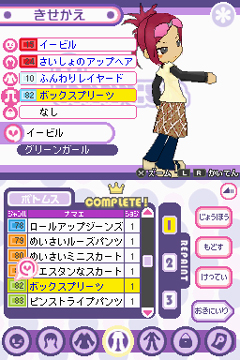
Not being well-versed in Japanese, I couldn’t read the dialogue bits in the cutscenes (although, after beating Music Hour, I was able to find fan translations of the script). There are a lot of cutscenes, too. In addition to the handful of cutscenes related to the core story, there’s one before and after each dance battle round. I must’ve spent just as much—or more—time looking at cutscenes than I had actually playing the games.

Cutscenes aside, here’s how the games are structured. The main character’s home base is at ANGELA, a club on George Hill. Here, Pucchi (or Evil) can practice dance routines for the songs unlocked to that point, save, connect to other players wirelessly, or access the wardrobe. This last part reflects Pinky:st’s core appeal: the mixing and matching of dozens of tops, bottoms, hairstyles, accessories, and so on. The sheer number of clothing articles is astonishing, and not only includes styles from the Pinky:st figure line, but also completely original ones. On top of that, each item has a total of three color variations, and up to ten complete outfits can be created and saved for easy access.

There are other neighborhoods in Rainbow Town besides George Hill. Each one has a ludicrously overpriced clothing store, an accessory-dispensing gashapon (capsule) machine, a place to take photos of the main character with a rudimentary camera feature, and a venue where the dance battles occur, devoted to a specific musical genre. Who participates in these battles and the number of songs for each genre varies between the two games, but the actual dance battle gameplay is the same. For these segments, the DS has to be held book-style, and the touchscreen is used to tap, swipe, and scratch the cues that pop up within three rectangular fields. It’s a simple enough system, but it breaks from the conventional wisdom of rhythm game design in some peculiar ways.

There are typically two schools of design when it comes to rhythm games: the “Simon Says” approach and the “scrolling cues” one. In a Simon Says rhythm game, such as Parappa the Rapper or Space Channel 5, the actions to be taken are played first by the game, and then the player repeats the same sequence. Those that use scrolling cues, including the Dance Dance Revolution and Rock Band games, offer a preview of the beats to hit as they scroll toward the goal. The Music Hour/Music Night approach lies somewhere in between. In these two games, cues for where the notes will appear briefly pop up in a small box at the top of the touchscreen, though these cues rarely indicate what type of action will be required (the aforementioned tapping, swiping, and scratching). This preview box also does not tie in to the rest of the playfield in any way, and in fact can distract from it.
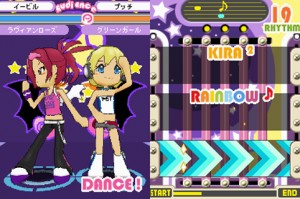
The dance segments have some other unique features. How the notes of each music track sound depends on how precisely they are played, which can result in some rather clunky sounding melodies. While an interesting approach, it can make it harder to determine how a track is supposed to sound. Other than pulling off a completely perfect performance, there is a way to hear tracks played properly, but it requires hoofing it back to ANGELA and going through the practice menu, without actually activating a practice. Then there’s the dancing itself: not only is it difficult to watch the Pinky characters dance on the opposite screen while playing (note that a replay button does become available at the end if you want to watch the simple dance animations), but there are also two measurements of how well a performance goes—and only one of them determines if you pass or fail. As in DDR, a grade is given at the end for how well the notes were hit, chains, and so on. However, there is also the “audience” meter, reminiscent of a similar feature in the PS1 dance battle game Bust a Groove, which shows how well your character fares against the Pinky NPC they’re up against. This second metric is the one that ultimately determines success, and because of that, it’s entirely possible to get a great grade on certain songs and fail. To call such a setup contradictory and maddening is an understatement; the game’s designers should’ve gone with either the grade system or the audience meter, not both.

Once a dance battle has been won, a small amount of money and a prize is issued—usually a new wardrobe item, or said item plus a P-Coin for use with the gashapon machines (for losing battles, only the money and sometimes a P-Coin is given). Speaking of money, as I said before, the clothing stores are overpriced. One has to do a lot of dance battles to build up enough capital to afford even the cheapest items, and even selling off unwanted goods doesn’t help, as only a very small amount is offered for them. That said, the best way to build up a decent wardrobe is simply to win the dance battles.

Finally, this wouldn’t be much of a rhythm game review if I didn’t talk about the music itself. Although the graphics are mostly lovely, with bright colors and clear, crisp designs, the music is, unfortunately, not as memorable. It’s actually fairly generic, and the only tracks that I found stuck in my head were the ones that I had trouble with in the game, and had thus played a dozen times over in hopes of getting past.

As licensed games from a small, and now-defunct, developer, I wasn’t expecting much. That said, these two were pretty much what I was expecting: mediocre, brief, and laden with Pinky:st fanservice. The Pinky figures themselves are all right as well, though the pegs on Evil’s front hair piece and base are too large (either that or the holes are too small). Evil also doesn’t come with as many extras as Pucchi, but like too few other figures in the line, has a ball-jointed neck. Nevertheless, both girls are now on display in my figure case, and their respective games have been filed away in my library, two more for the “beaten” pile.